

Payment Method
Overview
Payment Methods in Moneris API provide a secure way for merchants to represent customer payment details for use in supported payment flows. Instead of collecting or submitting the same payment details each time a customer makes a purchase, a merchant can create or use a Payment Method and reference it in supported Moneris API requests. Payment Methods can help simplify checkout, support repeat-customer experiences, and reduce the need for merchants to directly handle sensitive payment information, depending on the integration approach used.
What is Payment Method?
A Payment Method is a Moneris API resource that represents the payment details needed to process a transaction.
A Payment Method can represent different payment sources, such as:
- Card details
- A temporary token generated through Hosted Tokenization
- A permanent token from Moneris Vault, also known as a Data key
- Supported digital wallets, such as Apple Pay and Google Pay
A Payment Method does not represent a transaction by itself. Transaction-specific details such as amount, currency, capture behavior, invoice number, and order information are submitted as part of payment, validation, subscription, or follow-on transaction requests.
In simple terms, a Payment Method is the customer’s way of paying, represented in a secure and reusable format.
Payment Method vs Payment Method ID
A Payment Method is the full resource that contains the information Moneris needs to process the payment. A Payment Method ID is the unique identifier returned by Moneris for that Payment Method.
The merchant can store the Payment Method ID in their own system and use it in supported API requests instead of storing or resubmitting sensitive payment details.
Example:
Customer: John
Payment source: Card
Billing/contact details: Stored with the Payment Method where applicable
Moneris reference: Payment Method ID
If John has two cards on file, each card would have its own Payment Method ID.
Understanding Payment Method (Moneris API)
Imagine a customer visits your online store and creates an account. During this process, they typically provide several pieces of information, such as:
- Their addresses (shipping, billing, or home)
- Their preferred payment options (for example, one or more credit cards)
All of this information helps you complete a purchase. However, managing these details individually every time the customer wants to pay can become complex and inefficient.
Why Payment Methods exist
Without a reusable Payment Method, a merchant may need to collect or assemble payment-related information each time a customer makes a purchase. This can increase integration complexity, introduce unnecessary handling of sensitive information, and create a slower checkout experience.
The Payment Method model simplifies this by allowing merchants to represent payment details through a single secure reference.
Instead of repeatedly collecting or submitting the same payment information, the merchant can use a Payment Method ID in supported Moneris API flows.
How It Works in Practice
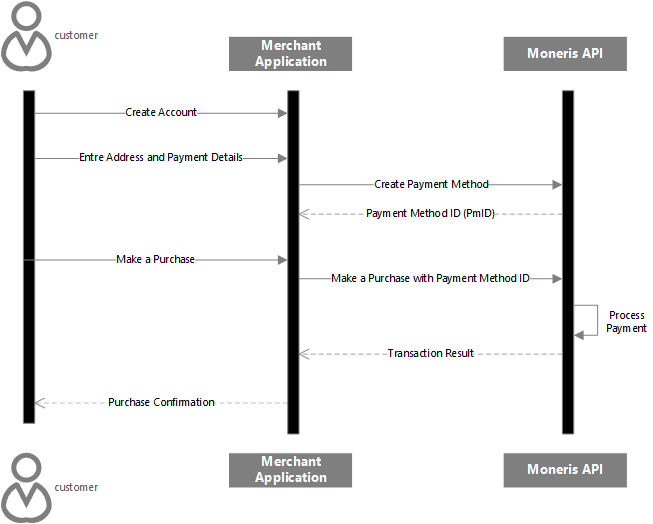
When the customer is ready to check out:
- You do not need to gather all payment details again
- You simply submit the Payment Method ID to the Moneris API
- Moneris uses the stored information to process the payment
Key Benefits
- Simplicity: Reduces the need to manage multiple pieces of payment data
- Efficiency: Speeds up checkout and simplifies your systems
- Security: Sensitive payment details are securely handled by Moneris
In addition, Payment Method enable merchants to bill customers later without collecting payment data again, keeps merchant out of PCI scope and solving several problems such as:
- Store once reuse for: recurring billing, subscriptions and one-click checkout
- User Experience: Faster checkout (no re-entry of details) and can be used “on file” in future transactions
- Security: Avoid handling raw card data repeatedly and use tokenization or vaulted identifiers
Summary
A Payment Method allows you to replace multiple pieces of payment-related information with a single, reusable reference. This makes the checkout process smoother, faster, and more secure for both you and your customers.
Updated 17 days ago